Xbox Series S to Get AMD’s FSR 4.1 Upscaling Technology With AI-Powered Image Reconstruction
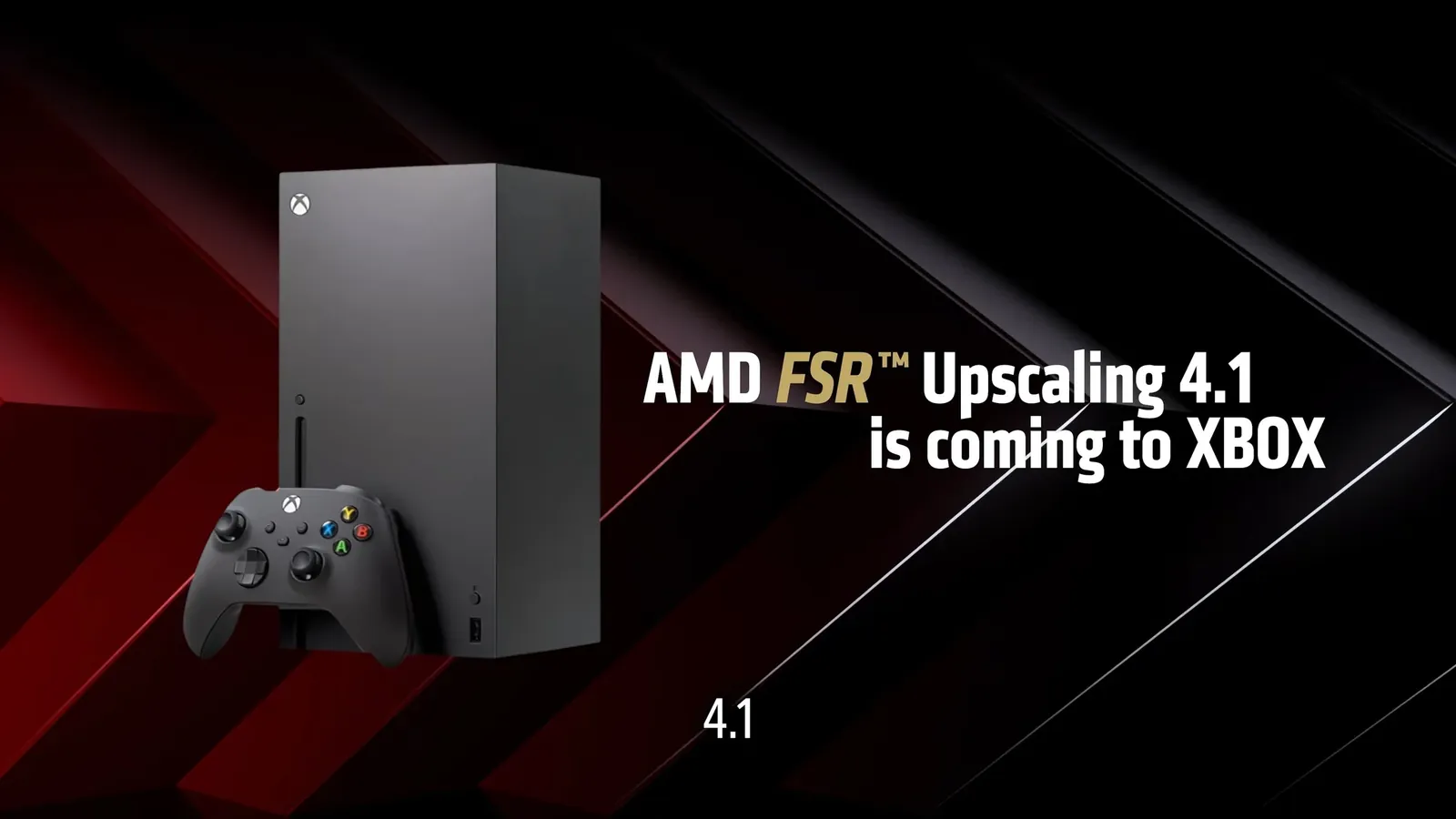
AMD has announced that its FSR 4.1 upscaling technology is coming to Microsoft's Xbox Series X|S consoles. The announcement, made on October 20, 2026, expands the collaboration between the chipmaker and Microsoft as both companies continue exploring ways to improve graphics performance through software.
The update could be particularly relevant to the Xbox Series S, which features a less powerful GPU and less memory than the Series X. Upscaling technology may help developers balance visual quality and performance, potentially making it easier to optimize demanding games for the more affordable console.
However, AMD and Microsoft have not yet provided a specific release date for the console update or published performance comparisons showing how much players can expect to gain.
How Does FSR 4.1 Work?
AMD's FSR 4.1 is an evolution of its image upscaling technology. Rather than rendering every frame at the display's full target resolution, the system uses machine learning to reconstruct a higher-resolution image from a lower-resolution render.
The goal is to reduce some of the computational workload associated with rendering while maintaining a high level of visual detail. Depending on the game and its implementation, this approach can improve image clarity or free up processing resources for other graphics tasks.
The technology also aims to address visual artifacts associated with temporal reconstruction techniques, including ghosting around moving objects and the loss of fine details in certain scenes.
Results can vary considerably between games. Image quality and performance depend on factors such as the original rendering resolution, graphics settings, and how developers integrate the technology into their rendering pipelines.
Why Could the Xbox Series S Benefit?
Microsoft positioned the Xbox Series S as the more affordable option in the current console generation. Its hardware configuration differs significantly from that of the Series X, requiring developers to make different optimization decisions when bringing demanding games to the platform.
Upscaling can help reduce the workload involved in rendering an image at a higher output resolution. In some games, this could translate into sharper visuals, more consistent frame rates, or additional room for graphics effects.
However, FSR 4.1 will not increase the console's physical GPU capabilities or add more memory. It also does not guarantee that every compatible game will achieve higher frame rates or run at 1080p and above.
The potential advantage is more efficient use of the hardware already available. The extent of any improvement will only become clear once developers implement the technology and performance tests become available.
What Does This Mean for Xbox Consoles?
The announcement is part of the broader collaboration between AMD and Microsoft to expand the graphics technologies available across the Xbox ecosystem.
Beyond the Series X|S consoles, AMD has also outlined plans to bring the technology to devices in the ROG Xbox Ally handheld lineup. On PC, the company has discussed expanding support across Radeon graphics hardware and selected Ryzen processors, subject to hardware and software requirements.
The announcement for current-generation consoles should also be distinguished from Microsoft's plans for its next generation of hardware. Microsoft has said Project Helix, its upcoming console initiative, will use FSR Diamond (the AMD technology first referred to as FSR Next), while FSR 4.1 is the technology associated with the current Xbox lineup.
These developments point to continued investment in machine-learning techniques to improve graphics without relying exclusively on more powerful hardware.
When Will FSR 4.1 Arrive on Xbox Series S?
AMD has confirmed plans to bring the technology to Xbox consoles, but a detailed rollout schedule has not yet been announced.
The companies have also not released a list of supported games or official benchmarks comparing current versions with future implementations of FSR 4.1.
Adoption will depend on developers and how the feature is integrated into individual titles. Players should therefore not expect an automatic improvement across every game installed on their consoles.
For Xbox Series S owners, the announcement represents a potential way to improve image reconstruction and rendering efficiency through software. The real-world benefits, however, will depend on the first compatible games and the performance results that follow.
Correction (October 21, 2026): an earlier version of this article said Microsoft had linked FSR Next to Project Helix. The technology is now called FSR Diamond, as Xbox CTO Scott Van Vliet confirmed on October 20.
Context
FSR (FidelityFX Super Resolution) is AMD's upscaling technology. FSR 4, the first version built on machine learning, launched in 2025 only on Radeon RX 9000 graphics cards. Version 4.1 reached the RX 7000 series in July 2026, and on October 20 AMD extended it to the RX 6000 series with an optimized INT8 model, in the Adrenalin 26.10.1 driver.
That last step is what opens the door for Xbox: the Series X and Series S use AMD RDNA 2 graphics, the same generation as the Radeon RX 6000 family. Sony already has its own machine-learning upscalers, PSSR on the PS5 Pro and QSSR on the standard PS5, which is why Wccftech framed FSR 4.1 as Xbox's answer to them.
What we know
- AMD and Microsoft announced it on October 20, 2026. Xbox CTO Scott Van Vliet said FSR 4.1 is "coming soon" to Xbox Series X|S and called AMD "an important partner" (Pure Xbox, Windows Central).
- The announced devices are Xbox Series X, Xbox Series S, the ROG Xbox Ally X and the base ROG Xbox Ally. For the handhelds, Windows Central cites a report of a preview through Armoury Crate on October 23.
- There is no date for the consoles. AMD's own announcement lists Series X|S as "coming soon" and gives no frame-rate figures.
- On PC, support arrived the same day for Radeon RX 6000 cards and Ryzen AI processors, including the chips in Ryzen AI Max PCs and the Z2 handhelds.
- Project Helix, the next Xbox, will use FSR Diamond, the name AMD now uses for what it first called FSR Next. Microsoft confirmed it in March 2026, and Tom's Hardware reports that Helix development kits are expected in 2027.
What we don't know yet
- Whether each game needs to be updated by its developer to use FSR 4.1 on Xbox, or whether older games can benefit. Van Vliet called it "another powerful tool" for developers, which suggests per-game work, but Microsoft has not given details.
- How much it costs to run on the Series S. AMD had to build a lighter INT8 model for older GPUs, which lack the AI hardware of the RX 9000 series, and no console benchmark has been published.
- Which games will be first, and whether GTA VI will use it. Rockstar has not said which upscaling technique the game uses on Xbox.
VICEVERSA's take
For a GTA site, this is the Xbox story that matters most this month. The Series S is the least powerful console GTA VI will run on, and its biggest weakness is image quality at low internal resolutions, which is exactly what a machine-learning upscaler improves.
Keep expectations in check, though. FSR 4.1 adds no raw power, there is no date or game list, and nothing indicates that GTA VI will support it on November 19. If it does arrive later in a patch, the Series S could gain the most from it.
Mike Novinski Pagani, editor